Quick Contact +91-11-25842122


 ICAR - Central Institute of Agricultural Engineering (CIAE)
ICAR-CIAE Abiotic stress detection device
Background
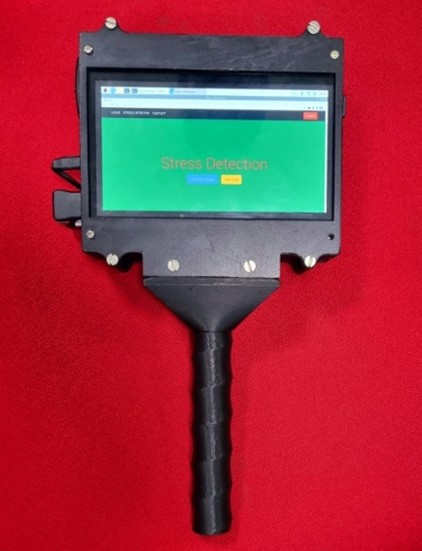
An AI-enabled mobile device was developed for real time identification of abiotic stress in field crops with the aim to assist crop breeding and precision crop input management. The device assembles a Raspberry Pi single board computer and a digital RGB camera. A validated transfer-learning based deep learning model “AlexNet” was used to process the captured images and classify into stressed or non-stressed categories in real time. The captured images and results are being displayed on a custom graphic user interface. The device is also capable of predicting the stress in-house from historically collected images input to the device. The results are produced in 200 milliseconds post-capture/feeding of the images. The device was field evaluated in wheat, maize and rice crops and pertinent stress classification accuracies were 81.5%, 68.3% and 80.2%, respectively for nitrogen stress. However, water stress occurred only on wheat and maize and it was classified with an accuracy of 68.6% and 67.5%, respectively. The experiment for rice was conducted under water logging condition, hence water stress not considered for rice. The developed device offers a user-friendly GUI to identify abiotic stress in real time for the crop breeders, researchers, and ultimately growers for timely decision making on plant health and crop yield improvement.
Technology Details
The proposed work involves the development of a low-cost, handheld, AI-enabled mobile device with GUI application that can identify abiotic stress in real-time using images captured locally or supplied remotely. This device is custom-built, open-source, portable and easy to use. The system utilizes a well-validated AI based Deep Learning (DL) model, which runs on a Raspberry Pi micro-controller. To validate its efficacy, the device was tested on three different field crops, including wheat, maize, and rice. The stress detector system consists of a Raspberry Pi 4 microcomputer board (B+, Raspberry Pi foundation), a capacitive touch screen (Robokit, HDMI 800×400 mm), an RGB camera module (Raspberry Pi V2, 8 MP, HFOV = 62.2°, VFOV = 48.8°, Sony IMX219, Raspberry Pi foundation), a 64 GB secure digital (SD) card, and a power source (MI power bank, 20000 mAh, 5V/2A). The stress detection system includes a graphical user interface (GUI) developed using JavaScript, which presents both raw images and results. At the back end, stress detection algorithms are executed using Python IDLE. The GUI includes a drop-down list that allows users to select the type of stress and the crop under evaluation. Additionally, users can choose to test the system in real-time using the camera or select testing images from a folder. The GUI is user-friendly and simplifies the process of evaluating stress in crops in early stages.


