Quick Contact +91-11-25842122


 ICAR - Central Institute of Agricultural Engineering (CIAE)
Unmanned multi-purpose track-type vehicle for small farms (UMTV) with attachments (a) Rotary tiller (b) Air-assisted sprayer (c) Multi-row planter and (d) Weeder
Unmanned multi-purpose track-type vehicle for small farms (UMTV) with attachments
(a) Rotary tiller (b) Air-assisted sprayer (c) Multi-row planter and (d) Weeder
Background:
In India, small and marginal farmers account for 86 % of total farmers and they contribute 47 % of total cropping area (Agriculture census, 2018). In view of scarcity of labour and need for timely completion of various farming operations, small and marginal farmers most commonly used walking tractors having engine power in the range of 6.62-8.95 kW because of affordable price and well-accepted source of power in India. Despite increased demand of walking tractor, the utilization still lags behind than that of tractors because of high drudgery while operation. Attempts have been made to use with different tillage implement with walking tractors but little success was achieved. Some of the research concluded that walking tractors fitted with rubber tracks could nearly double draught force developed when compared with pneumatic wheels for the same operating conditions. Apart from the that, the operators of walking tractor are exposed to a high level of vibrations transmitted from handles to hands, arms and shoulders. It was reporting continuous use of walking tractor causes serious health issue and resulted in many accidents while operation. Hence, it is also planned to develop the proposed system as an unmanned vehicle, it will be operated from out of field using remote-control system.
Technology Details:
A remote-controlled self-propelled track-type vehicle has been developed for small farms. The system consists of 8.9 kW petrol engine, a hydraulic transmission system, a track-type mechanism electronic control unit (ECU) with remote controller, real time monitoring vision system and anti-collision unit. The track-type system comprises a rubber track, load wheels, tensioners, drive wheels, rubber track tires, and a chassis frame. The hydraulic transmission system includes a hydraulic tank, a hydraulic pump, and remotely controlled electronic solenoid valves to transmit hydraulic power to the actuators (hydraulic motor and hydraulic cylinder). The hydraulic motor drives the drive wheels attached to the left and right track tyres, while the hydraulic cylinder facilitates the lifting and lowering of agricultural implements. The functions including direction, speed, braking and equipment operation can be remotely controlled from a distance of 500 m from safe place with ECU. The unit consists of real-time 2 vision-based monitoring system for long-distance operation and includes an emergency stop system to avoid collision during operation. The system enables remote operation from a safe location, ensuring operator safety eliminating exposure to adverse weather conditions and reduce human drudgery. The overall dimension of developed system is 1100 (L) x 695 (W) x 985 (H) mm. A rotary tiller, planter, rotary weeder and detection-based sprayer have been developed for compatibility with the remote-controlled multi-purpose track-type vehicle.
(A)Rotary tiller as an attachment to unmanned multi-purpose track-type vehicle (remote operated)
Background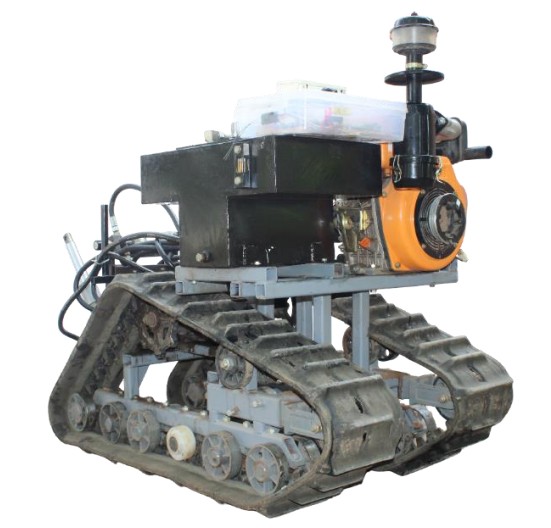
Small farms especially those located in hilly or fragmented regions, often lack access to efficient and safe mechanization wheeled vehicles. Traditional tillage using manual tools or conventional power tillers is labor-intensive, time-consuming and may pose safety risks on sloped or uneven terrain. The integration of a rotary tiller compatible with an unmanned multi-purpose track-type vehicle addresses these challenges by enabling remote control, precise and consistent soil preparation without the need for onboard operators. The unmanned track-type platform provides superior traction, stability and maneuverability, making it ideal for small plots with variable topography. This setup not only enhances operational efficiency and safety but also reduces soil compaction and fuel consumption, as evidenced by improved field efficiency and lower operational costs. The system supports timely land preparation, promotes uniform seedbed conditions, and contributes to sustainable and labor-saving to the needs of smallholder farmers.
Technology Details
A rotary tiller compatible to remote-controlled self-propelled track-type vehicle has been developed for small farms. This remote-controlled system allows for remote-controlled lifting and lowering of the tillage unit, as well as engagement and disengagement of the rotary blades, providing precise control without requiring an on-board operator. The comparative evaluation of UTV-RT and conventional power tillers clearly justifies the need for a rotary tiller attachment to an unmanned track-type vehicle for small farms. The UTV-RT demonstrated superior performance with a higher theoretical (0.146 ha/h) and effective field 4 capacity (0.11 ha/h), enabling faster land preparation than the power tiller. It also achieved a greater tillage depth (121.5 ± 12 mm) and wider cut (0.73 m), resulting in improved soil pulverization and better seedbed quality. Despite its slightly higher fuel consumption (1.81 l/h), the system is more cost-effective, with a lower operational cost of ₹3902/ha compared to ₹4172/ha for the power tiller. Additionally, it reduces the time required to prepare one hectare of land to 9.09 hours, enhancing timeliness in farm operations. Most importantly, as an unmanned system, it enhances operator safety, reduces human fatigue, and offers a viable solution for smallholder and hilly farms where manual operation poses challenges. These benefits collectively highlight the system’s efficiency, safety, and suitability for modern precision farming in small and difficult-to-access agricultural plots.
(B) Remote-operated air-assisted sprayer compatible to unmanned multi-purpose track-type vehicle
Background: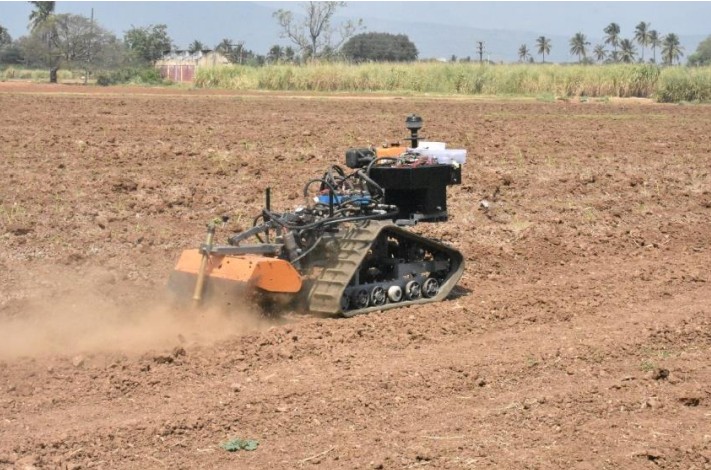
Traditional crop spraying methods in small farms primarily rely on manual knapsack or leveroperated sprayers, which are labor-intensive, time-consuming and often inefficient in achieving uniform chemical application. These methods require significant human effort, especially over large or difficult terrains, leading to operator fatigue and inconsistent spray coverage. Additionally, traditional sprayers typically produce large droplets and have limited reach, resulting in poor canopy penetration, increased chemical wastage and potential environmental contamination. Most critically, manual spraying exposes the operator directly to hazardous agrochemicals, posing serious health risks. In sloped or uneven fields, the use of wheeled machinery becomes impractical, further limiting the effectiveness of conventional methods. This background highlights the pressing need for more efficient, safer and terrain-adaptable spraying technologies for smallholder and hilly farms. Technology Details Small farms particularly those in hilly,
Technology Details:
Small farms particularly those in hilly, fragmented, or labor-scarce regions, often struggle with efficient and uniform pesticide due to the limitations of manual or conventional spraying methods. The development of an air-assisted sprayer as an attachment to an unmanned multipurpose track-type vehicle addresses these challenges by enabling precise, uniform and efficient spraying with minimal human intervention. The air-assist mechanism improves droplet 6 penetration and canopy coverage, while reducing drift and chemical wastage, thereby enhancing the effectiveness of crop protection. Operating at a forward speed of 2.1 km/h, the system ensures efficient spraying with a discharge rate of 7.9 ± 1.6 l/min and an optimal droplet size (VMD) of 194 µm, which enhances coverage while minimizing drift. The sprayer provides a maximum swath width of 9.2 meters and a vertical reach of up to 4.3 meters, making it suitable for both field crops and tall orchard crops. Its integration with a remote-controlled, track-based platform ensures safe operation on hilly or uneven terrain, protecting the operator from chemical exposure. With a fuel consumption of only 2.3 l/h, the system offers a cost-effective, precise, and safe alternative to manual spraying, supporting sustainable, climate-smart agricultural practices for smallholder farmers. The unmanned track-type platform ensures safe and stable operation on uneven terrain and narrow farm pathways, eliminating operator exposure to chemicals and enhancing safety. This solution not only improves application efficiency and timeliness, but also supports eco-friendly, cost-effective, and precision farming, making it highly suitable for sustainable agriculture in smallholder systems.
(c) Multi-row planter as an attachment to unmanned multi-purpose track-type vehicle
Background: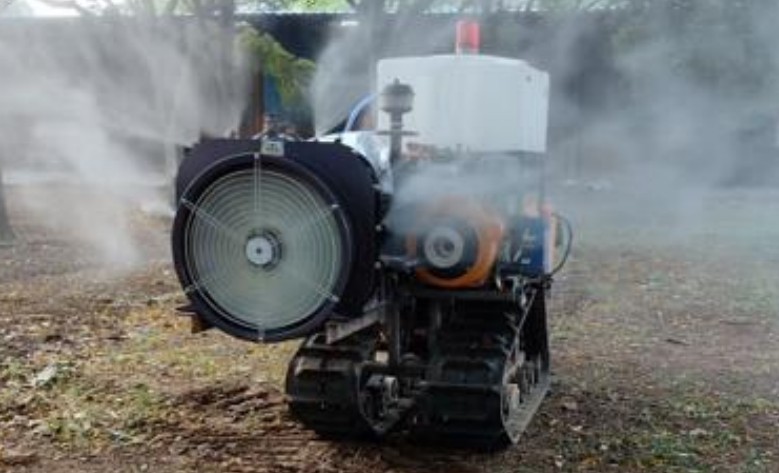
Traditional manual planting methods are laborious, time-consuming and often lack consistency in seed placement, leading to poor crop establishment. By integrating a multi-row planter with an unmanned tracked vehicle, smallholder farmers can achieve uniform plant spacing, optimal seed depth, and enhanced field efficiency, even in undulating or narrow field conditions. The tracked platform ensures better maneuverability, reduced soil compaction, and adaptability across various crops and terrains. This innovation not only increases productivity and input-use efficiency but also reduces dependency on labor, paving the way for cost-effective and scalable precision farming solutions for small farms.
Technology Details:
Small and marginal farmers particularly in hilly and fragmented regions, face significant challenges in achieving timely and uniform sowing due to labor shortages, difficult terrain and lack of appropriate mechanization. Conventional methods are labour-intensive, time-consuming 8 and often result in inconsistent planting, which directly affects crop yield and farm profitability. The requirement for a multi-row planter attached to an unmanned track-type vehicle arises from the need to deliver precision planting with minimal human intervention, ensuring uniform seed placement, optimized input use and reduced operational time. The unmanned track-type platform enables safe, stable and efficient movement across undulating landscapes where traditional wheeled machines are ineffective. This solution addresses the urgent demand for cost-effective, scalable and essential for transforming smallholder farming into a more sustainable and productive enterprise. The proposed solution involves the integration of a multi-row planter with an unmanned multipurpose track-type vehicle, specifically developed for crops like carrot. This system operates at a forward speed of 2.7 km/h with a working width of 0.6 m, offering precision planting through uniform plant spacing (41 ± 13 mm) and seed depth (34 ± 11 mm). The unmanned tracked platform provides excellent stability, traction, and mobility on sloped or uneven fields, making it ideal for small fragmented landholdings and challenging topography. With an effective field capacity of 0.13 ha/h, field efficiency of 78.02%, and low fuel consumption of 1.74 l/h, the system ensures efficient coverage (7.7 hours per hectare) while significantly reducing operator fatigue and manual errors.
(d) Weeder as an attachment to unmanned multi-purpose track-type vehicle
Background: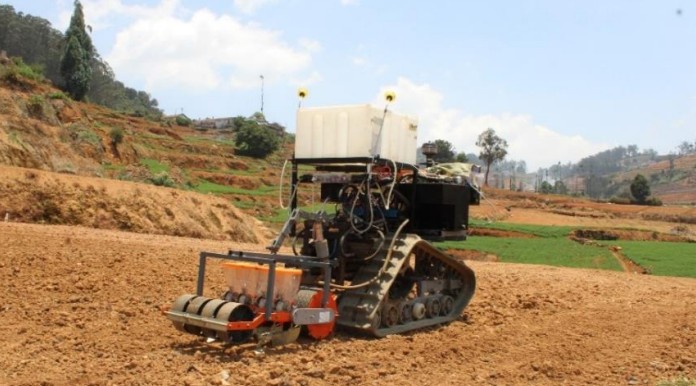
Manual weeding is labour-intensive, time-consuming and often ineffective over large areas, especially in regions facing labour shortages and challenging terrain. Integrating a rotary weeder with an unmanned tracked platform enhances operational efficiency, ensures uniform weeding and reduces human drudgery. The tracked mobility offers superior traction and stability on uneven, wet or sloped fields, making it highly suitable for diverse cropping systems. This innovation supports the vision of precision farming, lowers input costs, minimizes crop damage and promotes eco-friendly weed control by reducing the dependence on herbicides.
Technology Details:
A remote-controlled self-propelled track-type vehicle has been developed for small farms. The system consists of 8.9 kW petrol engine, a hydraulic transmission system, a track-type mechanism electronic control unit (ECU) with remote controller, real time monitoring vision system and anti-collision unit. The track-type system comprises a rubber track, load wheels, 10 tensioners, drive wheels, rubber track tires, and a chassis frame. The hydraulic transmission system includes a hydraulic tank, a hydraulic pump, and remotely controlled electronic solenoid valves to transmit hydraulic power to the actuators (hydraulic motor and hydraulic cylinder). The hydraulic motor drives the drive wheels attached to the left and right track tyres, while the hydraulic cylinder facilitates the lifting and lowering of agricultural implements. The functions including direction, speed, braking and equipment operation can be remotely controlled from a distance of 500 m from safe place with ECU. The unit consists of real-time vision-based monitoring system for long-distance operation and includes an emergency stop system to avoid collision during operation. The system enables remote operation from a safe location, ensuring operator safety eliminating exposure to adverse weather conditions and reduce human drudgery. The overall dimension of developed system is 1100 (L) x 695 (W) x 985 (H) mm. A rotary tiller, planter, rotary weeder and detection-based sprayer have been developed for compatibility with the remote-controlled multi-purpose track-type vehicle.


