Quick Contact +91-11-25842122


 ICAR - Central Institute of Agricultural Engineering (CIAE)
Tractor Front Mounted Hydraulic Tree Pruner
Background
Pruning is a horticultural practice involving the selective removal of certain parts of a plant, such as branches, buds or roots. Pruning fruit trees helps produce good annual yields of quality fruit. This practice develops a strong framework that increases the tree’s life and reduces loss from limb breakage. Insufficient pruning of bearing trees may result in small, poorly colored fruit with low sugar content and mediocre flavor. Trees that are over pruned may also produce poorly colored fruit, although of large size. In addition to affecting fruit quality, pruning affects the fruiting potential of the tree for the following year. The small orchardist or home fruit grower use hand tools for pruning. Hand shears, lopping shears, pole pruners, and pruning saws of various sizes and styles are available. Hand tools are the simplest pruning equipment for a small orchard, yet the operation is not economical and time-consuming. Commercial orchardists have adopted a variety of power-driven small equipment to make pruning easier, faster, and more efficient.
 Technology Details
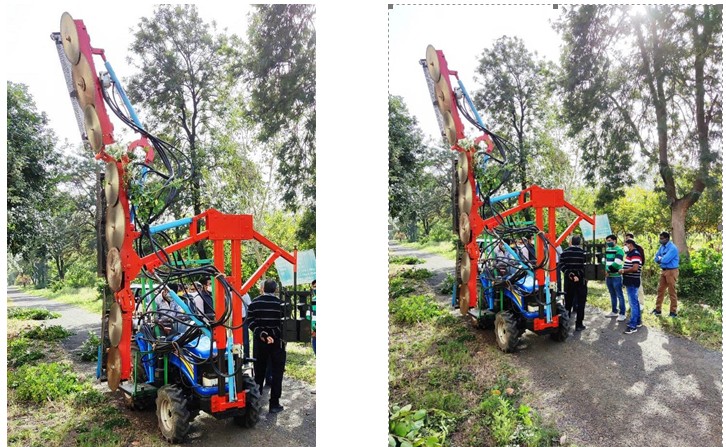
The major components of the pruning system include a PTO-driven hydraulic power pack, hydraulic cylinders, hydraulic motors, control valves, an air-cooled DC cooling radiator, and circular saw blades. The pruning system includes eight circular saw blades with diameters of 500 and 400 mm and tooth counts of 100. The pruner is rigidly attached to the front of the tractor with four bolts and nuts. With the assistance of hydraulic cylinders, the height of cut as well as the angle of inclination of the blade gangs can be adjusted to give the proper shape to the canopy. With the adjustment of height, the pruner can prune up to a height of 3.5 m. The hydraulic system is designed to rotate the blades at about 2500 rpm.


