Quick Contact +91-11-25842122


 ICAR - Central Institute of Agricultural Engineering (CIAE)
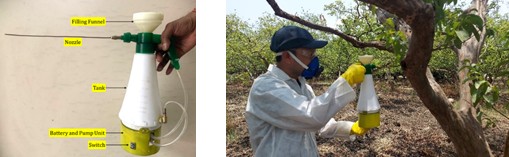
CIAE-Battery operated chemical injector for orchard crops
Background
In litchi or several other fruit crops, caterpillars bore inside the trunk/main stem and adversely affect the yield and quality of fruits. Caterpillars remain within the bored holes during the day, come out at night, and feed upon the bark. Generally, older trees are more susceptible. Infestation may be noticed by the presence of ribbons of wood chips, frass and silken thread over the bark surface. To overcome this problem, traditionally the infested plant parts are being cleaned and cotton wool soaked in kerosine oil or nuvacron or formalin is inserted in the hole with help of bicycle spoke and plugged with moist mud of fresh cow dung. Also, removal and burning of the ribbon-like silken webs containing the caterpillars hiding under them are practiced.
Technology Details
A battery-operated chemical injector for orchard crops has been developed for spraying kerosene, petrol, insecticides or formalin in the caterpillar holes present on the litchi, guava trees and other horticulture trees to control bark eating caterpillars. It consists of pump (diaphragm type, R385, max lift: 3000 mm, max suction: 2000 mm, flow rate: 1.5-2.0 L/min, operating voltage: 6-12 V DC), tank (capacity: 1000 ml), rechargeable battery and a nozzle integrated with flexible capillary tube, having outer diameter of 2 mm, inner diameter of 1 mm and length of 280 mm. This extension in the nozzle helps in applying chemicals in the caterpillar holes of a litchi tree. The chemical injector has overall dimensions of 380 mm × 450 mm × 140 mm and capacity of 1000 ml. The pump was used in the chemical injector to pump chemicals into the tree. The pump was operated by a combination of two rechargeable batteries (v: 7.4V) which is integrated in the chemical injector. The operating period of the system is 3 hr with one set of battery. Preliminary trial of the injector has been conducted on guava tree since similar kind of caterpillar infection has been found in litchi tree. The average application time per tree has been found to be less than a minute. The spraying system is handy and safer in operation than conventionally adopted bore hole spraying method.